
Table of Contents
If you are an English speaker thinking about learning Arabic, one of the first questions you probably ask is simple and honest: Is Arabic hard to learn?
Arabic often has a reputation for being one of the most difficult languages in the world, especially for English speakers. But the short answer is this: Arabic is more challenging than some languages, but it is not nearly as hard as many people are led to believe.
What usually makes Arabic feel difficult is not the language itself, but how it is traditionally taught and how learners are told they “should” approach it.
Why Arabic Can Feel Challenging at First
There are a few real reasons why Arabic feels harder than languages like Spanish or French for English speakers.
First, Arabic uses a different writing system. The script is unfamiliar, it is written from right to left, and letters change shape depending on their position in a word. That alone can feel intimidating at the beginning.
Second, Arabic has very few cognates with English. In many European languages, you can often guess the meaning of words because they look similar to English. Arabic words usually do not resemble anything you already know, so vocabulary takes more time to build.
These are real challenges. They do mean that Arabic requires more patience and long term commitment. But they do not mean that Arabic is “too hard” or unrealistic to learn.
The Bigger Problem: How Arabic Is Often Taught
In practice, most learners struggle not because Arabic is inherently difficult, but because of how it has traditionally been presented.
For decades, Arabic instruction has focused heavily on Modern Standard Arabic, formal grammar explanations, grammatical terminology, and early mastery of reading and writing. This approach resembles how Latin used to be taught, very analytical, very rule heavy, and very abstract.
For beginners, this can be overwhelming. Learners are often told they must master the script, memorize complex grammar rules, and understand formal sentence structures before they can say anything useful. That combination makes Arabic feel discouraging right from the start.
This is especially true for Modern Standard Arabic, which has more complex grammar than the spoken varieties people actually use in daily life.
Spoken Arabic Is Much Simpler Than You Think
One of the biggest misconceptions about Arabic is that you must start with Modern Standard Arabic. In reality, spoken Arabic varieties, such as Egyptian Arabic, Levantine Arabic, or others, are grammatically simpler and far more practical for everyday communication.
Spoken Arabic allows learners to:
• communicate immediately
• focus on listening and speaking
• avoid unnecessary grammatical complexity early on
Starting with a spoken variety does not mean you are “learning Arabic wrong.” It means you are learning it the same way people actually use it.
Trying to learn Modern Standard Arabic and a spoken dialect at the same time, especially as a beginner, often slows progress and increases frustration. Doing one well first is far more effective.
Why Audio First Learning Makes Arabic Easier
Another common mistake beginners make is trying to do everything at once. Reading, writing, grammar, vocabulary, and speaking all from day one.
For Arabic, this approach often backfires.
Focusing on audio first helps learners:
• build accurate pronunciation
• internalize sentence patterns naturally
• increase vocabulary without visual overload
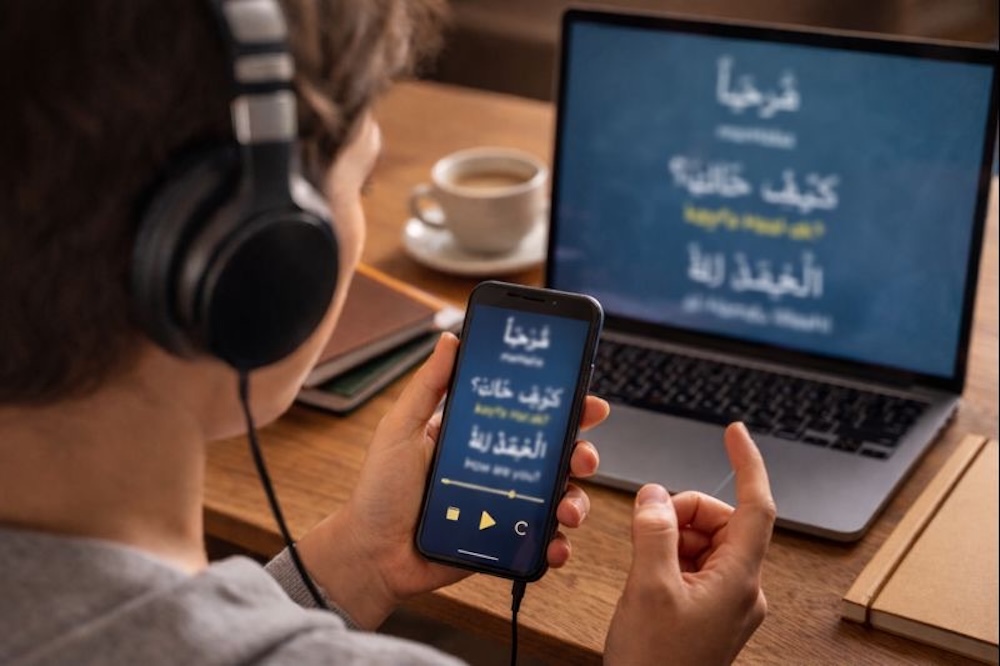
There is nothing wrong with delaying the Arabic script for several months. You can still make excellent progress by learning to understand and speak the language first. Once the sounds and structures feel familiar, learning to read and write becomes much easier and less stressful.
So Is Arabic Hard for English Speakers?
Arabic does take more time than some languages. It requires patience, consistent exposure, and realistic expectations. But it is not unreasonably difficult, and it is certainly not only for “gifted” language learners.
When Arabic is taught with a focus on spoken language, audio based learning, and real communication, most learners progress far faster than they expect.
The difficulty of Arabic is often exaggerated. With modern materials and a practical approach, it becomes a challenging but very achievable language.
Where to Go Next
If you are curious about how spoken Arabic compares to Modern Standard Arabic, or whether you should learn the Arabic script first, those topics deserve their own deeper discussion.