
Table of Contents
The Intermediate Arabic Plateau
Many intermediate students reach a frustrating point where, despite years of study, they feel completely lost the moment they step into a natural setting. You might understand your teacher or your textbook’s CD perfectly, yet feel overwhelmed by a simple conversation in a Cairo café or a shop in Ramallah. This disconnect happens because most traditional materials rely on “sanitized” Arabic—scripted dialogues that are unnaturally slow, grammatically flawless, and devoid of the character of real speech.
The “Voices” series serves as your bridge between that polished classroom theory and the vibrant reality of how people actually communicate. We prioritize authentic, unscripted recordings to help you move beyond textbook “perfection” and develop the listening and reading skills necessary to navigate the real world with confidence.
What is the Arabic Voices Series?
The series is a curated collection of listening and reading practice materials designed for intermediate to advanced learners at the B1 and B2 levels. It provides a structured environment to encounter the language as it exists in the wild.
Comprehensive Collections
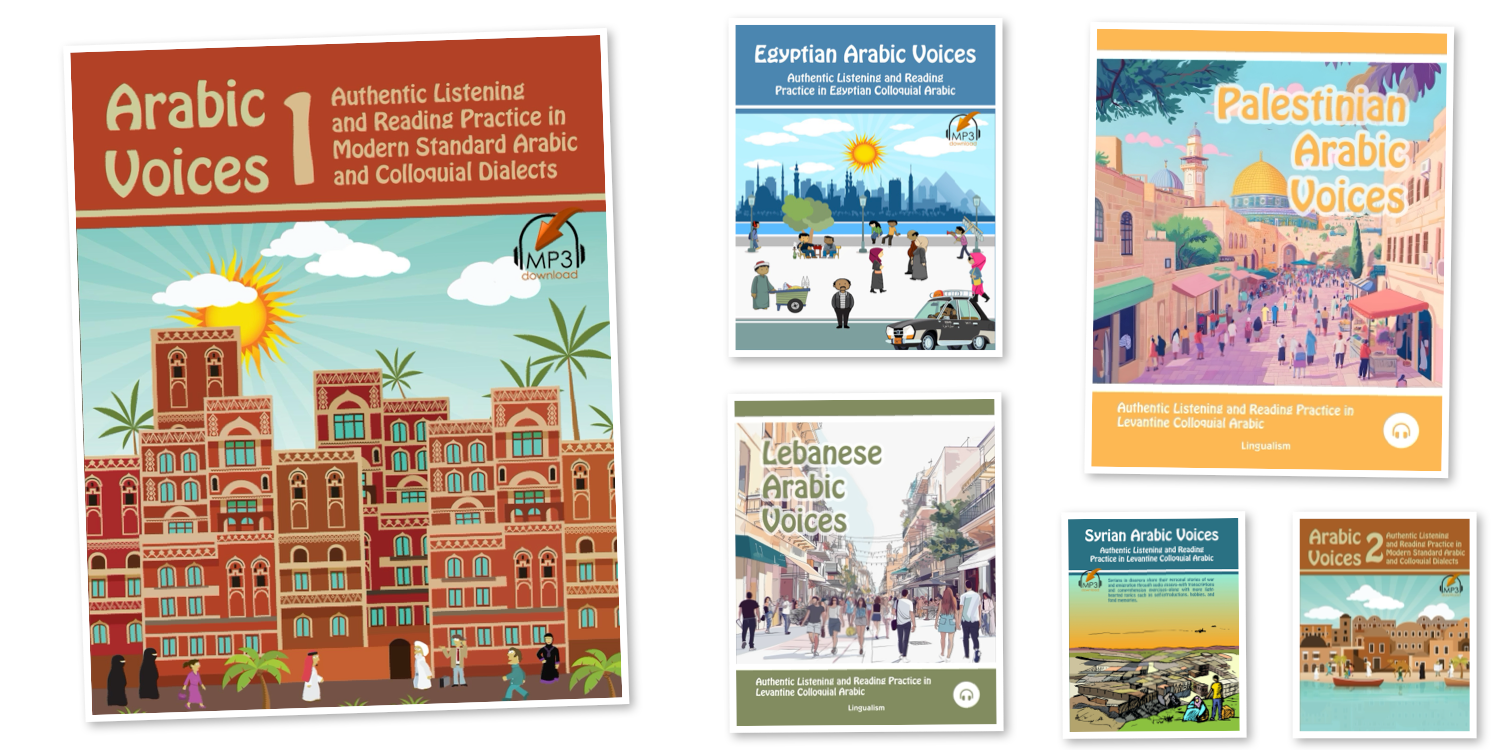
- Arabic Voices 1: This volume introduces 28 authentic segments from twelve participants across the Arab world, including Syria, Iraq, Morocco, Egypt, Jordan, Yemen, Tunisia, and Lebanon. It covers foundational topics like personal introductions, childhood memories, and university life.
- Arabic Voices 2: Advancing to more complex territory, this book features 29 segments focused on identity, social reality, and cultural history across seven different regions.
Regional Focus Books
If you are specializing in a specific dialect, the series offers dedicated volumes. Each contains 36 spontaneous audio essays that dive deep into the local linguistic and cultural landscape:
- Egyptian Arabic Voices (featuring six speakers from the greater Cairo region).
- Lebanese Arabic Voices (voices from Sidon, Akkar, and Beirut).
- Syrian Arabic Voices (perspectives from Homs, Aleppo, and Damascus).
- Palestinian Arabic Voices (including participants from both Gaza and the West Bank).
These materials are available as PDF eBooks for digital study or as paperback editions for those who prefer a tactile experience.
The Methodology: Why “Authentic” Speech is the Key to Progress
To reach fluency, you must embrace what we call the “beautiful mess” of spontaneous speech. In this series, we replace artificial dialogues with “audio essays”—unscripted monologues where contributors speak freely about their lives and societies.
Mastering this “messiness” is actually a shortcut to fluency. The recordings capture:
- Natural fillers and hesitations: Frequent use of words like ya’ni (meaning/like). Learning to hear and use these fillers is vital; they buy the speaker processing time and make your own speech sound native.
- Spontaneous rephrasing: The pauses, restarts, and “mistakes” that even native speakers naturally make when organizing thoughts on the fly.
- Varied delivery: Changes in speech rate and regional pronunciation that reflect the true rhythms of contemporary Arabic.
Exposure to these elements trains your “listening muscle” to process the speed and idiosyncrasies of the real world.
A Look Inside: Tools for Deep Comprehension
Each chapter is a structured laboratory for your Arabic listening practice, providing layers of support to ensure you never stay lost for long.
Spontaneous Audio Segments
Each book contains between 28 and 36 segments. These are human windows into diverse perspectives, such as Nihad’s memories of a Palestinian village without electricity or Nada’s account of the Syrian revolution.
Multi-Layered Transcripts
In Arabic Voices 1 and 2, We provide Arabic script with minimalist voweling to encourage natural reading habits. The Lebanese, Palestinian, Syrian, and Egyptian volumes use Arabic script transcriptions with diacritics to guide your pronunciation. The Egyptian volume also includes phonemic transcriptions to highlight specific sound patterns.
Side-by-Side Literal Translations
Direct translations reveal how Arabic sentences are structured, helping learners understand how meaning is built rather than relying on polished English equivalents.
Dialect-to-MSA Matching
To bridge the gap between your classroom foundation and regional dialects, the comprehensive collections (Arabic Voices 1 & 2) include matching activities with three columns, linking Modern Standard Arabic, dialect forms, and English. These exercises help you see the direct relationship between the Arabic you have learned and the colloquial variations you hear.
Speaker Data and Cultural Notes
Each segment includes data on word counts and speech rates. Furthermore, cultural notes provide context for regional habits, such as the Kuwaiti practice of pronouncing “kaf” as a “ch” sound or the Tunisian use of French loanwords.
Supplementary Video Lessons
Both Arabic Voices 1 and 2 include access to free video lessons featuring teacher Mostafa Ahmed. He provides deep dives into the Modern Standard Arabic segments, pointing out grammatical nuances and explaining “speaker slips” to help you learn from natural mistakes.
The Step-by-Step Strategy for Effective Arabic Listening Practice
To ensure your ears—and not just your eyes—are doing the work, follow this four-step process.
- Orient with Context: Study the “Key Words” first. This establishes a vocabulary safety net so your brain has “hooks” to catch the audio.
- Lead with the Ears: Listen to the audio several times without looking at the text. Your only goal at this stage is to identify the “Main Idea.”
- Deepen Understanding: Use the structured exercises (True/False, Multiple Choice, and Matching) to hunt for specific details. This forces your brain to filter the “noise” for meaning.
- Analyze and Consolidate: Finally, consult the side-by-side text and translation for close reading. Once you understand the text, use the Shadowing technique—play the audio and mirror the speaker’s intonation and rhythm in real-time to internalize the natural flow of the language.
Important Tip: Resist the urge to look at the text too early. If the answer is visible, your ear stops performing the difficult work required for growth.
Why This Series Works for Self-Study Learners
The “Voices” series is built for the independent learner who needs results that translate to the street.
- Improved Confidence: We celebrate progress over perfection. Moving from 10% comprehension to 50% on a fast-paced segment is a massive victory and a sign of real neural adaptation.
- Practical Flexibility: All audio is available for free streaming or MP3 download. For those worried about speed, Egyptian Arabic Voices includes additional “very slow” versions recorded by voice artists to help you catch individual sounds.
- Academic Rigor: This is a trusted resource used by government agencies and universities. It has also been professionally reviewed in Al-ʿArabiyya: Journal of the American Association of Teachers of Arabic.
Who Should Use the Voices Series?
The ideal user is an intermediate or advanced learner who has a solid foundation but feels “stuck.” If you are transitioning from Modern Standard Arabic to a specific dialect, or if you simply want to understand the Arabic people actually speak in everyday life, these materials provide the necessary immersion without the frustration of being totally unsupported.
Conclusion: Transforming Noise into Meaning
The ultimate goal of language study is to understand real people in all their complexity. Success isn’t found in 100% perfection on your first listen, but in the steady progress of training your brain to recognize patterns in the spontaneous speech of others.
Stop treating Arabic as a puzzle to be solved and start hearing it as a language to be lived. You can begin training your ears today by exploring the series, downloading a free PDF sample to see the layout, or diving into the free audio streams to experience the rhythm of authentic Arabic for yourself.