
Table of Contents
The “Wall” of Authentic Arabic Media
Many learners of Modern Standard Arabic reach a frustrating plateau where they can navigate classroom discussions or coffee shop conversations with ease, yet feel utterly defeated when opening an Arabic news site. This “intermediate plateau” is a common hurdle. It occurs when standard textbook Arabic fails to provide the specialized terminology and nuance required to decode native-level reporting. The transition from general conversation to professional media literacy often feels like hitting a wall of complexity.
The Media Arabic Vocabulary series provides a pedagogical bridge over this gap. Designed to move learners from “textbook” structures to the authentic language of journalists and commentators, this series focuses on how vocabulary functions in context. By shifting the focus toward functional literacy, the series helps you gain the intuition needed to process broadcasts and articles independently.
What is the Media Arabic Vocabulary Series?
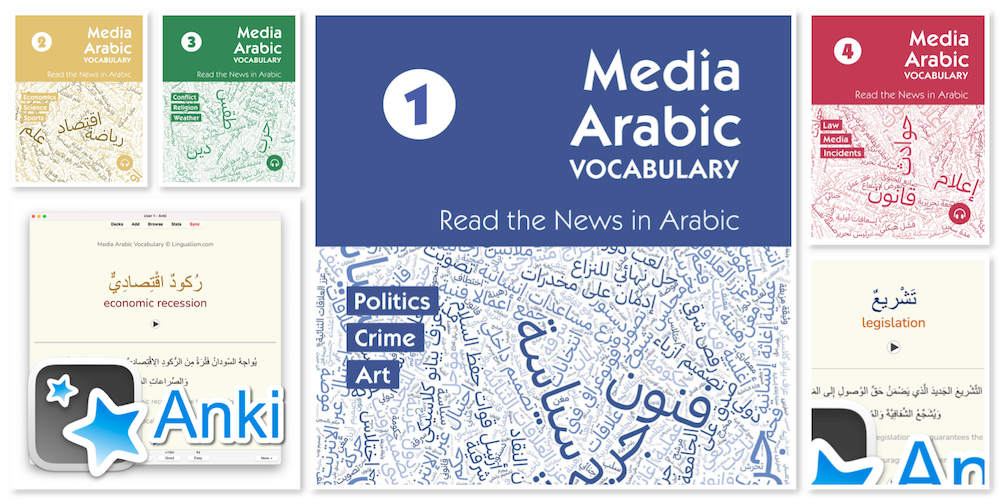
This resource is a comprehensive four-volume series tailored for B2 and C1 level learners. It provides the specialized jargon and cultural context essential for participating in professional Arabic discourse. The series is organized into broad thematic units, further divided into granular subtopics that reflect the reality of modern reporting.
- Volume 1: Politics, Crime, and Arts. This volume covers national governance, international relations, violent crime, and the performing and visual arts.
- Volume 2: Economics/Business, Science/Technology, and Sports. Learners explore macroeconomics (including monetary and fiscal policy), industrial manufacturing, and rare science content such as biology, chemistry, and clean energy.
- Volume 3: Military/Conflict, Religion/Society, and Weather/Natural Disasters. Units focus on asymmetrical warfare, Islamic philosophy, social issues like extremism, and climate change.
- Volume 4: Law/Justice, Media/Journalism, and Accidents/Incidents. This volume introduces a distinct register of professional language, covering intellectual property, courtroom dynamics, investigative ethics, and medical emergencies.
A Different Methodology: The “Controlled Text” Approach
The series employs a “controlled text” philosophy to ensure efficiency. Rather than overwhelming students with raw, unedited news, the material provides realistic media contexts at a manageable level. This approach allows for a low-stress environment while maintaining high-level learning.
The Self-Discovery Method
This methodology intentionally moves away from traditional “busy work” and multiple-choice drills. You are encouraged to act as an investigator, using vocabulary lists to observe how words interact and form collocations (natural word pairings) within authentic articles. This active engagement forces the brain to recognize patterns and nuances that passive memorization often misses.
Progressive Difficulty and Authentic Anchors
The material is structured to provide quick wins through “mini-articles” before advancing to complex native-style formats. The series uses significant historical and modern events to ground your learning in reality:
- Historical Reports: Encounter substantive texts on the Oslo Accords, the 1973 War, the Naksa, and the trial of Hosni Mubarak.
- Modern Reporting: Analyze investigative essays on fake news, the role of social media in the Egyptian Revolution, and factual reports on the Hajj stampede or the disappearance of Flight 370.
Key Features for Efficient Self-Study
The eBooks integrate several specialist tools to eliminate the need for external dictionaries and support independent study:
- Full Diacritics (Tashkeel): Every text—from example sentences to long-form essays—is fully voweled to ensure your pronunciation remains accurate.
- English Translations: Full translations for every sentence serve as a safety net. You can clarify technical terminology or complex syntax instantly without breaking your reading flow.
- Audio: High-quality tracks help you tune your ear to the specific rhythm and cadence of formal professional reporting.
- Example-Driven Learning: Topical vocabulary lists illustrate every entry with a functional example sentence, demonstrating exactly how the jargon is used in a reporting context.
Accelerated Retention with Anki Flashcards
To ensure long-term retention of specialized Media Arabic, the series offers companion Anki decks. These decks utilize the science of Spaced Repetition (SRS) to schedule reviews at the optimal moment before you are likely to forget.
The cards are organized into sub-decks by unit, allowing for targeted study:
- Precision and Depth: Each deck is comprehensive. Volume 3 contains over 2,900 cards, while Volume 4 includes more than 2,000 cards.
- Comprehensive Data: Cards feature high-quality audio, irregular plurals, and verbal nouns (masdars).
- Contextual Inference: Arabic-English cards display example sentences as hints. This encourages you to deduce meanings from context before revealing the answer. English-Arabic cards then challenge you to reconstruct the professional terminology and full sentences.
Who Should Use This Series?
The Media Arabic Vocabulary series is designed for intermediate learners who possess a firm grasp of grammar but lack the specialized lexicon of the professional world.
- Adult Self-Study Learners: Those seeking a structured, low-stress path to advanced literacy.
- STEM Students: Learners who rarely find technical Arabic content will benefit from the expansive sub-decks on information technology, AI, and environmental science.
- Regional Observers: Professionals and students interested in the political, legal, and social issues of the Arabic-speaking world.
How to Use the Series Effectively
The flexibility of the series allows you to customize your learning path based on your professional or personal needs:
- Follow Interests: There is no requirement to read cover to cover. Start with units that align with your passions, whether it is monetary policy in Volume 2 or international law in Volume 4.
- Consistent Review: Use the Anki sub-decks daily. Science-based repetition is the most effective way to internalize specialized terminology.
- Active Listening: Utilize the free MP3 downloads or the YouTube audio streams to emulate the pronunciation of professional reporters. These audio resources are available to all learners, even without a purchase of the eBooks.
Conclusion: From Student to Informed Observer
By moving from memorized lists to analyzing how language operates in professional registers, you gain the tools necessary to navigate Arabic newspapers and broadcasts independently. The Media Arabic Vocabulary series shifts your role from a student of the language to an informed observer of global events.
To begin your transition to media literacy, explore the full series at the Lingualism store. Bundle and Save options offer a 15% discount for eBook and Anki pairings, the complete eBook bundle, or the full Anki-only bundle.