

This online lesson is based on a single sentence taken from One Thousand and One Nights for Elementary Egyptian Arabic Language Learners, a reader that utilizes simplified classic tales and repetitive language structures to help adult learners acquire Egyptian Arabic naturally.
In the opening chapter, we are introduced to Scheherazade, a brave and intelligent girl who uses her gift for storytelling to captivate King Shahryar. On their wedding night, her first story is so engaging that it fundamentally changes the King’s plans. This lesson focuses on the construction used to describe an action or quality that reaches such an intense level that it produces a specific result.
The Sentence
كانِت القِصّة حِلْوَة أَوي لِدرجِةْ إنّ الملِك كان عايِزْها تِحْكيلُه قِصص كمان.
(kānit ilqíʂʂa ɧílwa ʔáwi li-dáragit ʔinn ilmálik kān 3ayízha tiɧkīlu qíʂaʂ kamān)
The story was so interesting (very sweet) that the king wanted her to tell him more stories.
The Breakdown
- كانِت القِصّة – “the story was” The verb “to be” (kan) takes the feminine suffix -it to match the feminine noun qíʂʂa (story).
- حِلْوَة أَوي – “very sweet” In Egyptian Arabic, the intensifier ʔáwi follows the adjective.
- لِدرجِةْ إنّ – “To the degree that…” This is our target structure. It links the intensity of the first clause to the result in the second clause.
- تِحْكيلُه – “she tells him” A combination of the verb tíɧki (she tells) and the prepositional pronoun –lu (to him).
- كمان – “more” or “also” This common word indicates the King’s desire for the storytelling to continue.
Mastering the Structure لِدرجِةْ إنّ “To the Degree That”
The structure لِدرجِةْ إنّ (li-dáragit ʔinn) is the Egyptian Arabic equivalent of “so… that.” To use it, you state an adjective + أَوي (ʔáwi), followed by لِدرجِةْ إنّ, and then the resulting action. If a pronoun (like “he”) is the subject of the second part, it attaches directly to إنّ (ʔinn): → إنُّه (that he…)
Here are two simple examples using vocabulary from other chapters in the book*:
- “الجِنّي كان غضْبان أَوي لِدرجِةْ إنُّه كان عايِز يِقْتِل التّاجِر” (ilgínni kān ɣaɖbān ʔáwi li-dáragit ʔínnu kān 3āyiz yíʔtil ittāgir) – The genie was so angry that he wanted to kill the merchant.
- “الصّيّاد كان سَعيد أَوي لِدرجِةْ إنُّه ساب السّمكة” (iʂʂayyād kān sa3īd ʔáwi li-dáragit ʔínnu sāb issámaka) – The fisherman was so happy that he let the fish go.
Source: 1001 Nights for Elementary Egyptian Arabic Language Learners
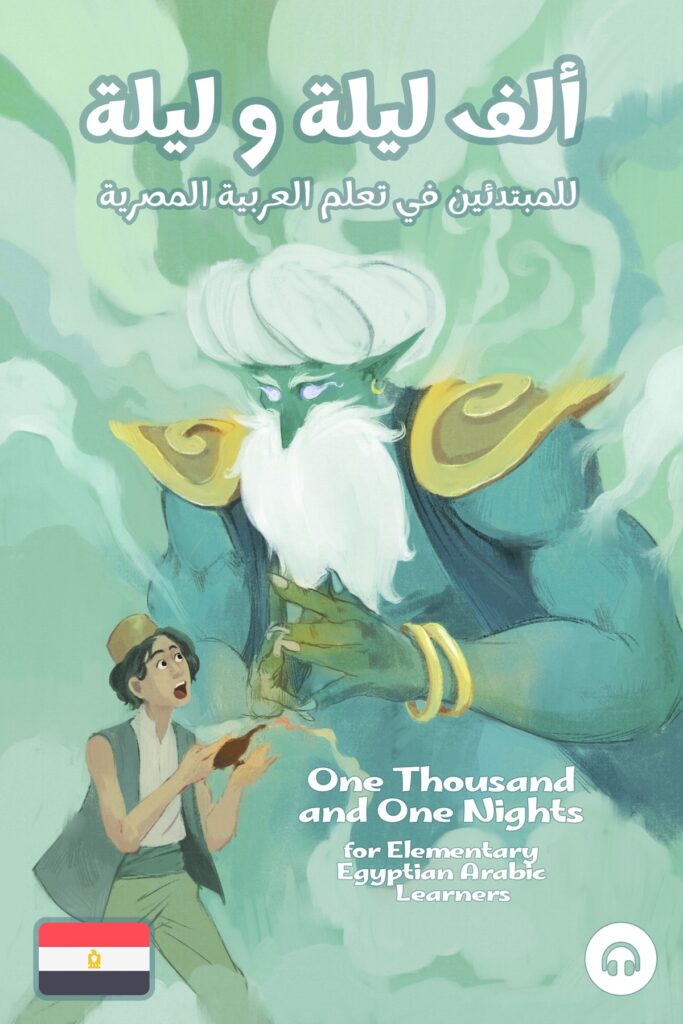
One Thousand and One Nights (Elementary – Egyptian Arabic)
A graded Egyptian Arabic reader that presents simplified One Thousand and One Nights stories with audio, translations, and comprehension questions for elementary learners.