
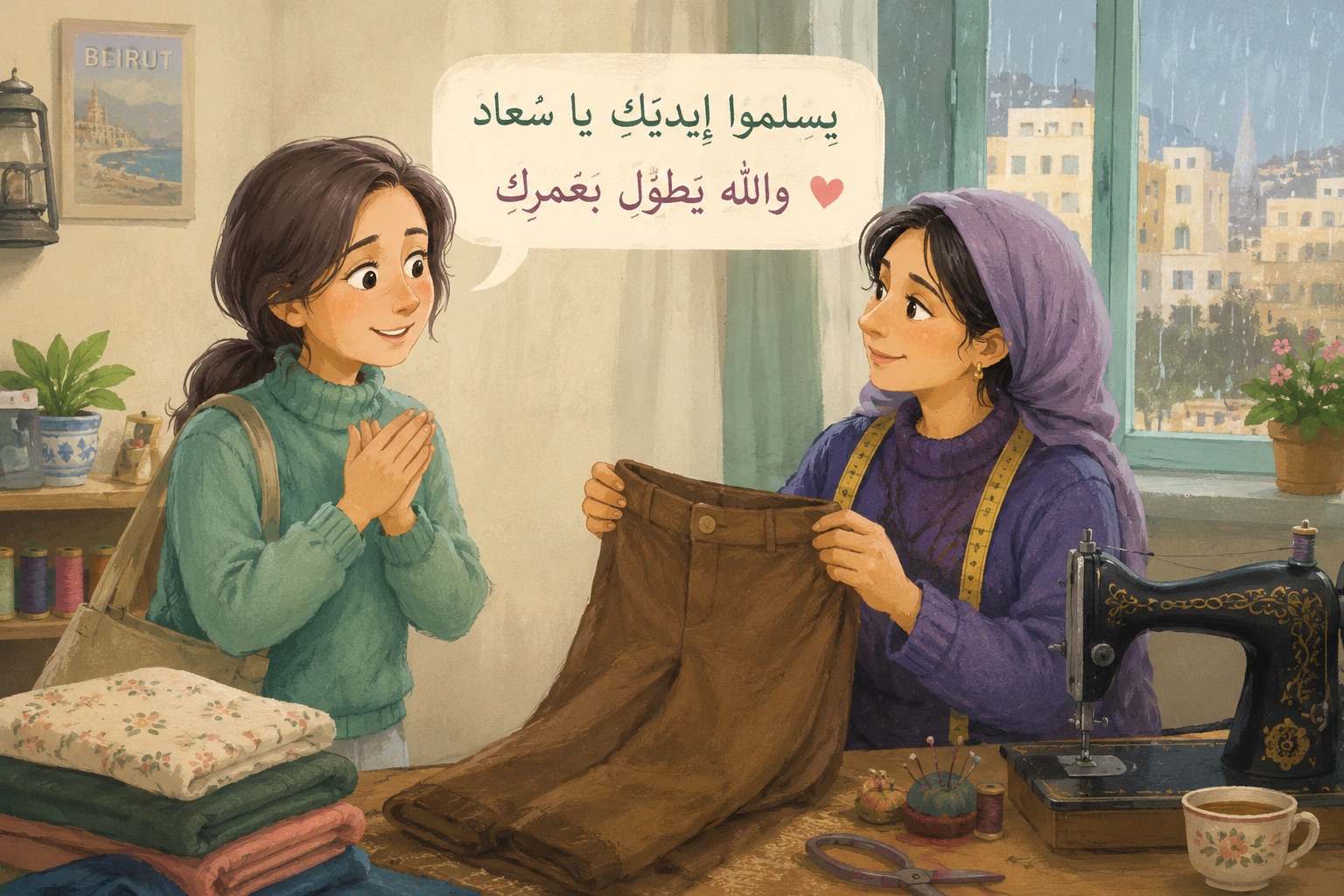
This online lesson is based on a sentence taken from the story Samir and His Brown Trousers, an elementary-level reader by Habeeb Yaghy designed to help learners improve their Arabic skills while vividly experiencing Lebanon’s cultural context.
In this story, Samir‘s mother (Umm Samir) is worried about her son being cold during the stormy Beirut winters. She provides a piece of cloth to her cousin Souad, a skilled seamstress, to make a pair of trousers for him. When the work is completed, Umm Samir uses a quintessential Lebanese blessing to express her gratitude. This structure is a “power phrase” for learners. It moves beyond a simple “thank you” to acknowledge the specific effort someone has made for you.
The Sentence
يِسْلموا إيدَيْكِ يا سُعاد واللّه يْطوِّل بِعُمْرِك.
(yislamo ideiki ya suʕaad u-allah yṭawwil bi-ʕumrik)
Thank you, Souad (literally: may your hands be kept safe), and may God prolong your life.
The Breakdown
- يِسْلموا( yislamo): This verb means “to be kept safe” or “to be sound”. It is used here as a wish for the person’s health and protection.
- إيدَيْكِ( ideiki): This means “your hands” (specifically the dual form used when speaking to a female). The blessing targets the hands because they are the tools used to perform the work or favor.
- يا سُعاد (ya suʕaad): In Arabic, the particle “ya” is almost always used when addressing someone directly by their name.
- اللّه يْطوِّل بِعُمْرِك (allah yṭawwil bi-ʕumrik): A common supplementary blessing meaning “may God prolong your life”. It is frequently paired with other thanks to show deep respect.
Cultural Background: The Language of Gratitude
In Lebanese society, social interactions are often reinforced by “reactionary” blessings—specific phrases that respond to specific actions. While shukran (thank you) is universal, using يِسْلموا إيدَيْك (yislamo ideik) is much more personal and culturally resonant.
This phrase is used whenever someone creates or provides something physical for you. You would say it to:
- A seamstress who finished your clothes.
- A host who cooked a meal or served you a drink.
- A neighbor who brings you sweets, like the baklavaor maamoul Souad offers her guests.
By blessing the person’s hands, you are specifically honoring the labor and craftsmanship they provided. In the story, this reflects the high value placed on skills like Souad’s, who learned sewing at a young age in the old neighborhoods of Beirut and served clients ranging from city-dwellers to those in the villages.
Final Tip: Mastering “Yislamo Ideiki”
To use this naturally, remember to match the ending to the person you are speaking to:
- To a female: يِسْلموا إيدَيْكِ Yislamo ideiki (as seen in the core sentence).
- To a male: يِسْلموا إيدَيْك Yislamo ideik (e.g., if you were thanking Souad’s husband for handing you medicine or a tool).
Practical Example: If someone serves you a cup of cocoa—as Umm Adel does for the children in the story—you can show your appreciation by saying: “يِسْلموا إيدَيْكِ”.
Source: Samir and His Brown Trousers: An Elementary-Level Levantine Arabic Reader
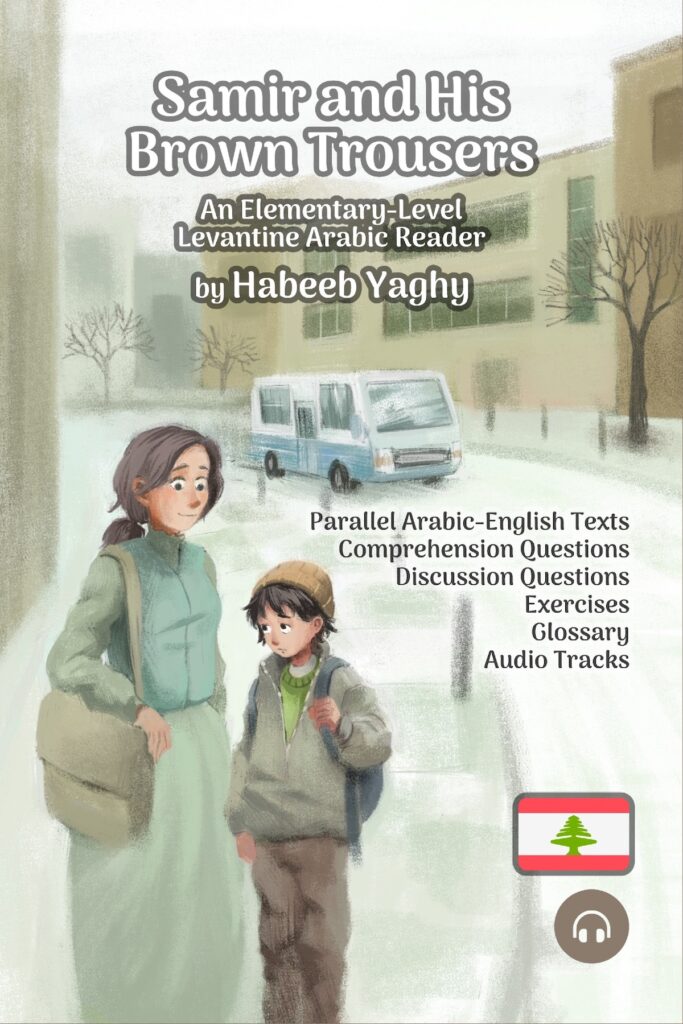
Samir and His Brown Trousers (Levantine Arabic)
An elementary Lebanese Arabic reader set in Beirut, with translation, extensive exercises, and native-speaker audio.