
This online lesson is based on a single sentence taken from Media Arabic Vocabulary: Book 1, a resource specifically designed to help intermediate learners bridge the gap between classroom Arabic and the complex, authentic materials found in news articles.
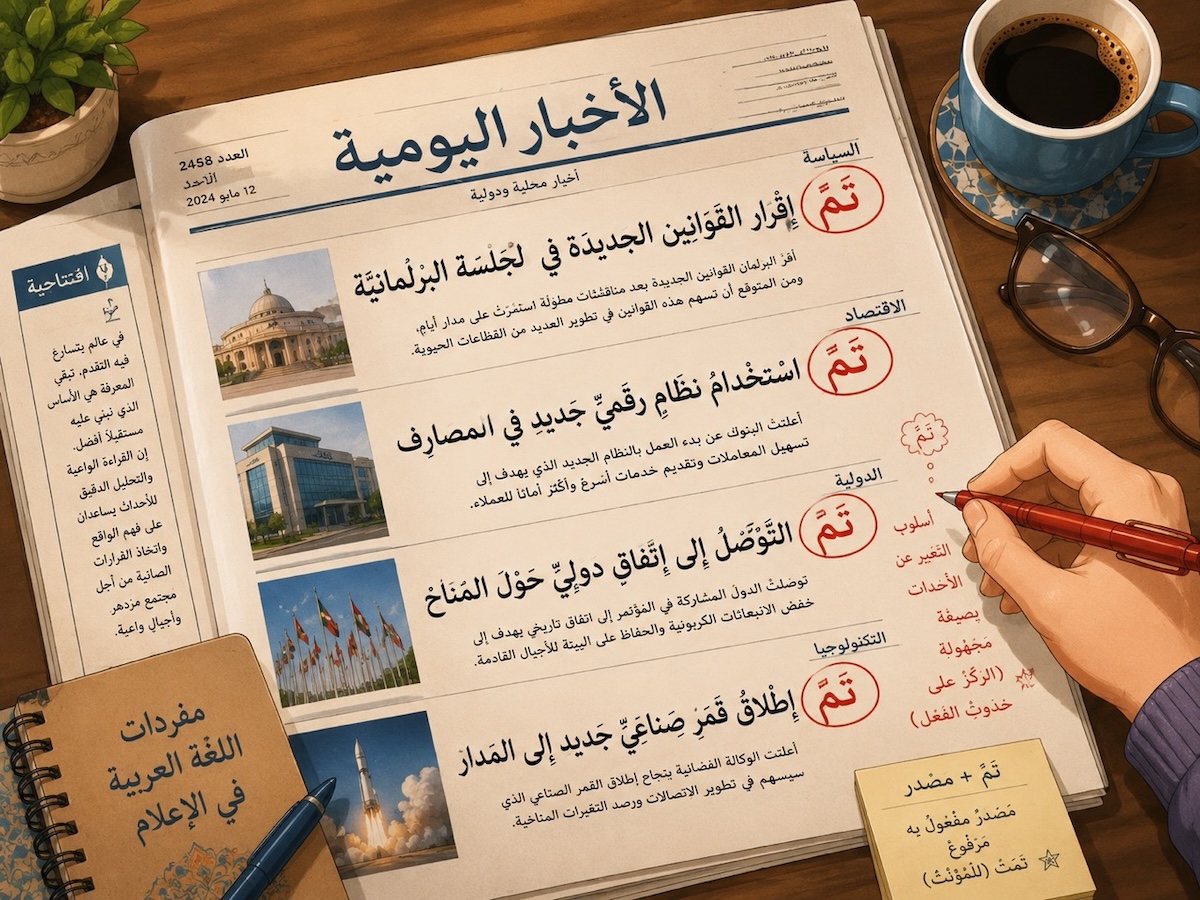
In professional journalism, writers often prefer an objective, impersonal tone. Instead of using a standard passive verb (e.g., “was issued”), Media Arabic frequently uses a construction with the verb تَمَّ (tamma). This lesson focuses on this essential structure, which allows you to describe actions as completed events without needing to identify a specific actor.
The Sentence
تَمَّ إِصْدارُ قَرارٍ جَديدٍ يَقْضي بِزِيادَةِ الرَّواتِبِ لِلْمُوَظَّفينَ الحُكومِيّينَ بِنِسْبَةِ 5٪.
A new decision was issued to increase the salaries of government employees by 5%.
The Breakdown
- تَمَّ (tamma): This verb literally means “to be completed” or “to be finished”. In this construction, it functions like an auxiliary verb to indicate that an action happened.
- إِصْدارُ (iṣdār): This is the masdar (verbal noun) of the verb aṣdara (to issue), meaning “the issuing”. In this structure, the masdar acts as the subject of the verb tamma.
- قَرارٍ (qarār): “A decision.”.
- يَقْضي (yaqḍī): A high-frequency verb in administrative Arabic meaning “to stipulate,” “to provide for,” or “to require.”.
- بِنِسْبَةِ (bi-nisbati): “By a percentage [of]” or “at a rate [of].”.
Final Tip: Mastering the “Tamma + Masdar” Structure
The structure تَمَّ + Masdar is the preferred way to express the passive voice in formal Arabic media. It is considered more professional than the standard passive because it focuses entirely on the completion of the action rather than the person who performed it.
To use it, ensure the verb تَمَّ matches the gender of your masdar. If the masdar is feminine, use تَمَّتْ.
Here are several other examples of this structure found throughout the book:
- Regarding Elections: “تَمَّتْ إِعادَةُ إِجْراءِ الِانْتِخاباتِ” (Elections were rerun; literally: the repeating of the conducting of elections was completed).
- Regarding Technology: “تَمَّ اسْتِخْدامُ التَّصْويتِ الإِلِكْتِرونِيِّ” (Electronic voting was used).
- Regarding Law: “تَمَّ إِقْرارُ القَوانينِ الجَديدَةِ” (The new laws were enacted/approved).
- Regarding Diplomacy: “تَمَّ التَّوَصُّلُ إِلى اتِّفاقٍ دَوْلِيٍّ” (An international agreement was reached).
- Regarding Policy: “تَمَّتِ المُوافَقَةُ عَلى خُطَّةِ الإِنْقاذِ” (The rescue plan was approved).
Source: Media Arabic Vocabulary: Book 1.
Media Arabic Vocabulary 1
Designed for intermediate learners who understand Arabic grammar but feel overwhelmed by authentic news articles, this book focuses on how media vocabulary actually functions inside political reporting, crime coverage, and cultural journalism. Rather than memorizing isolated words, you learn how vocabulary operates within real media contexts through example sentences and short articles.