
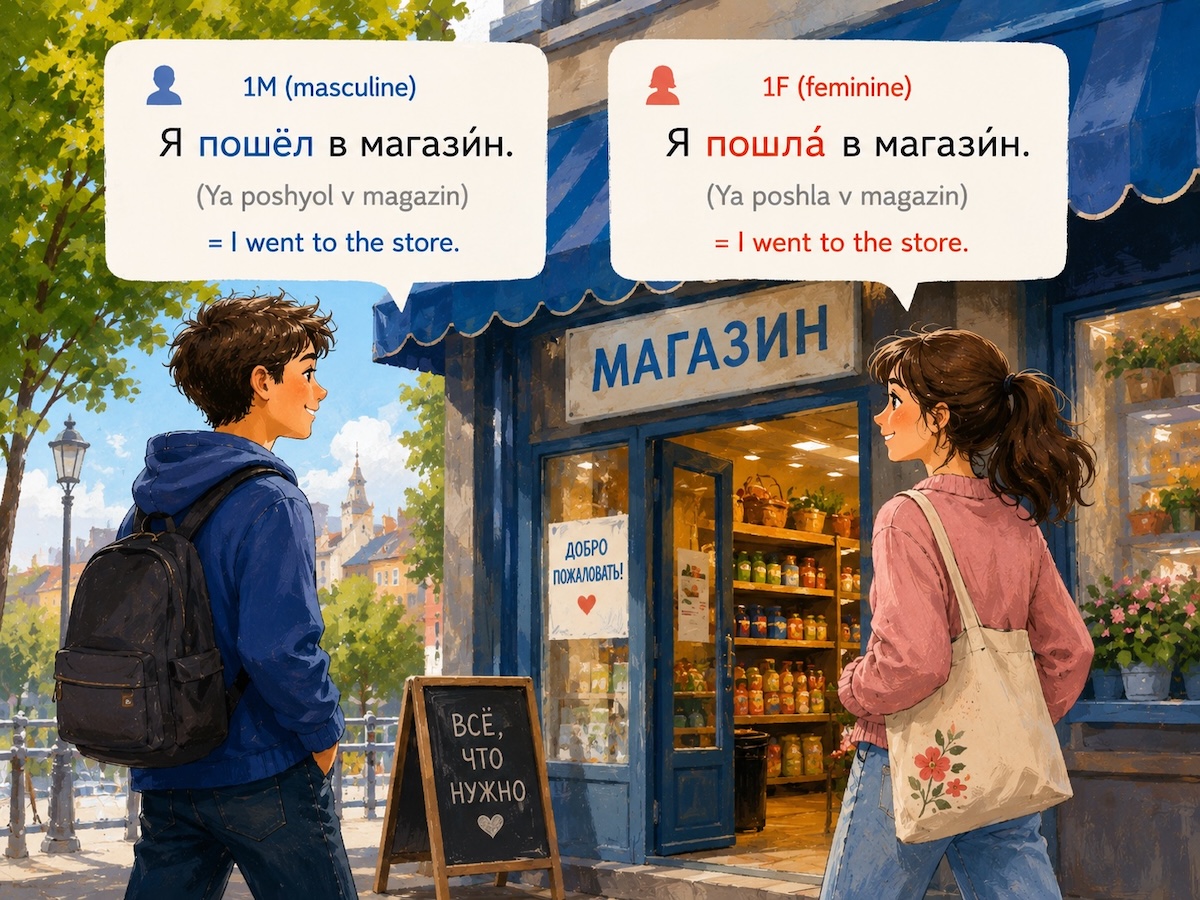
This online lesson is based on a single sentence taken from Random Russian A1 Book 1, a resource designed for beginning learners that emphasizes the repetition of natural language structures to build fluency.
One of the first major rules a Russian learner encounters is that the past tense isn’t just about when something happened, but who did it. In Russian, past tense verbs must agree with the gender of the subject. The book makes this clear by providing two versions of many sentences: 1M(for a male speaker) and 1F(for a female speaker).
The Sentence
1M: “Я пошёл в магази́н.” (Ya poshyol v magazin)
1F: “Я пошла́ в магази́н.” (Ya poshla v magazin)
“I went to the store”.
The Breakdown
- Я (Ya): “I.”This pronoun is gender-neutral, so the verb must do the work of showing who is speaking.
- пошёл / пошла́ (poshyol / poshla): “Went.”This is the past tense of the verb “to go” (perfective). The masculine form ends in -л, while the feminine form adds -а.
- в (v): A preposition meaning “to”or “into.”
- магази́н (magazin): “Store”.
- Stress Marks: Notice the symbols over the vowels (like и́ in магази́н). These are used throughout the book to help you with pronunciation, as Russian stress is often unpredictable.
Final Tip: Mastering Gender Shifts in the Past Tense
In the past tense, the most important thing to remember is the final letter of the verb. If the subject is a man, the verb usually ends in -л. If the subject is a woman, you add an -аto make it -ла.
You can see this consistent pattern across many actions in the book:
- Playing Soccer: Я игра́л (Masculine) vs. Я игра́ла (Feminine).
- Watching a Movie: Я смотре́л (Masculine) vs. Я смотре́ла (Feminine).
- Visiting Family: Я навести́л (Masculine) vs. Я навести́ла (Feminine).
Sometimes, other words in the sentence change too! When saying “I was a student,” the word for student changes gender along with the verb: Я был студе́нтом (M) vs. Я была́ студе́нткой (F).
Source: Random Russian A1 Book 1
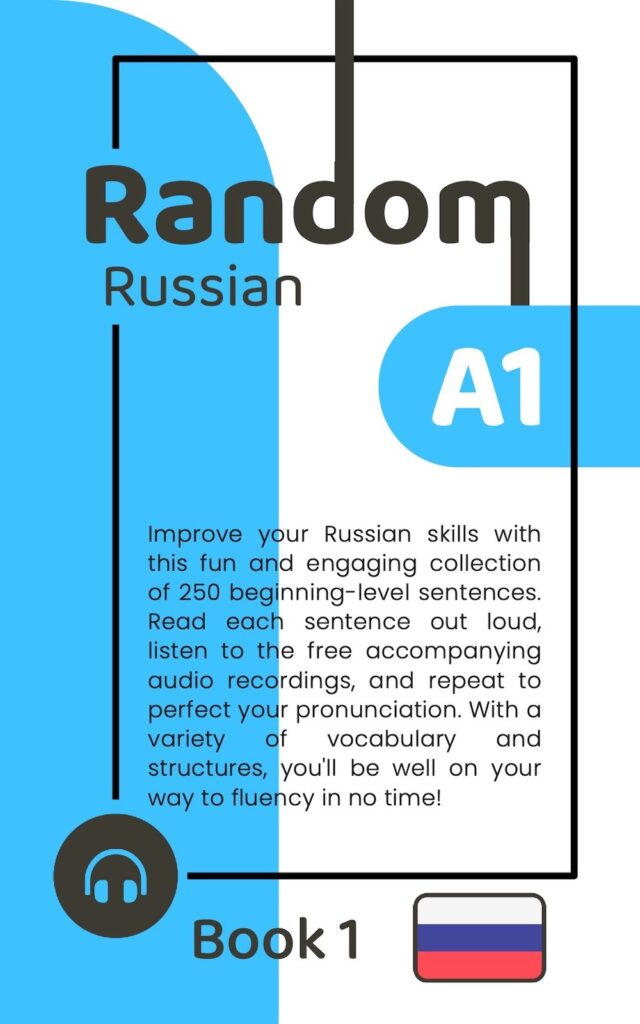
Random Russian A1 (Book 1)
250 beginning-level sentences with English translations and accompanying audio tracks.